Better Smart Contract Audits That Last

Preserve the credibility of your existing audits
by re-running audit-grade checks when code changes.

Designed to integrate with your CI/CD pipeline, SARIF workflows, and existing audit processes.

Trusted by audit-experienced Web3 teams

Including teams operating audited contracts in production.

Version-linked. Publicly verifiable. No marketing edits.

Audits are static, real security is not.

Most audits lose relevance when code changes.

What teams run into:

  • Forced $20k–$70k re-audits for minor updates
  • Weeks of blocked shipping while unchanged logic is rechecked
  • No clear answer to:
    “Does the deployed code still match what was audited?”

Fidesium is designed to prevent that.

Maintains audit continuity

⚠︎ Detecting when updates invalidate audit assumptions

⚠︎ Re-running audit-grade checks only where logic evolves

⚠︎ Preserving a verifiable, version-linked audit history

The result

Fewer re-audits.
Lower costs.
Audits that remain defensible as your code evolves.

Audit continuity before, during, and after deployment

Designed to support manual audits before, during, and after deployment.

Developer Tooling (Pre-Deployment)

Catch audit-relevant changes before they expand audit scope.

  • GitHub / GitLab CI integration
  • PR-level checks on meaningful logic changes
  • Context-aware detectors (not noisy scanners)
  • Clear remediation guidance
 
Outcome:

Smaller diffs → smaller audit scope → fewer surprises.

Automated Smart Contract Audits

Audit-grade checks that re-run as your code evolves.

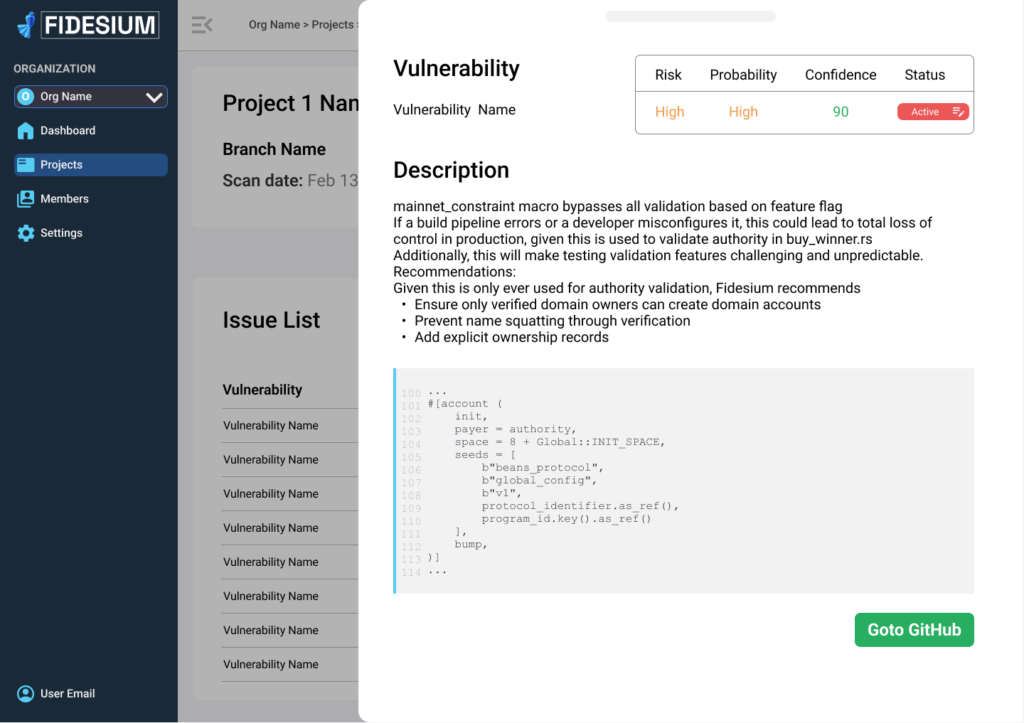
  • Logic & invariant analysis
  • Dependency and cross-contract checks
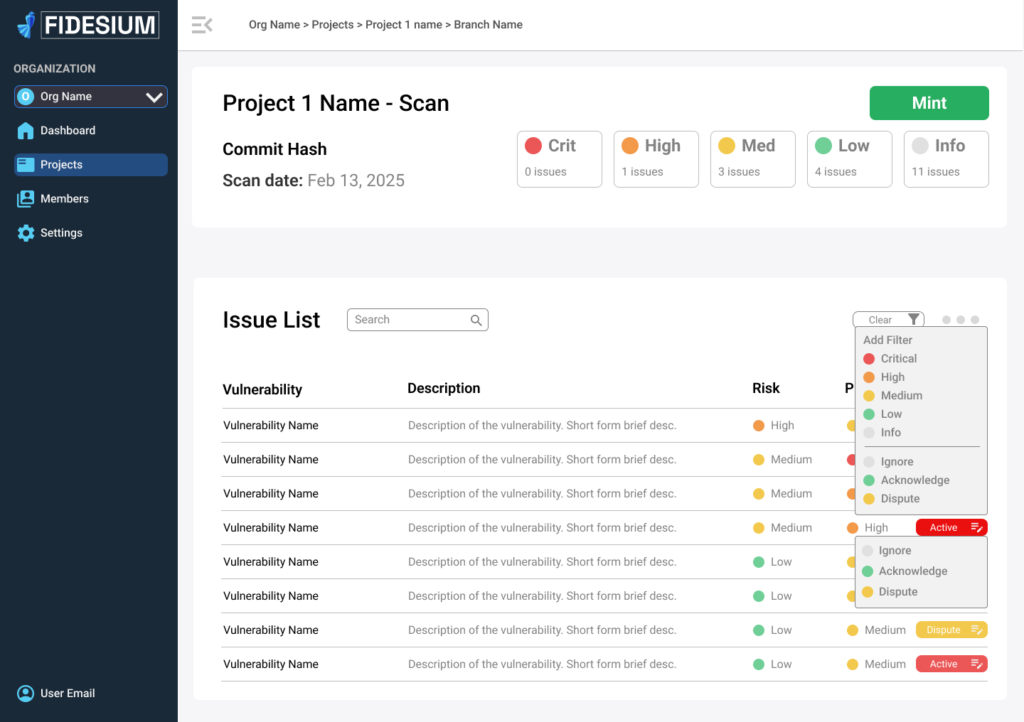
  • Risk scoring tied to commit
Outcome:

Audits stay relevant without constant re-audits.


On-Chain Attestation

Turn security work into verifiable, version-linked evidence.

  • Immutable on-chain attestations
  • Audit history tied to specific code states
  • Clear linkage between audits, updates, and deployments
  •  
Outcome:

Trust without rereading PDFs.

For:

Founders, institutions, and auditors who need defensible proof.

Built to support audits in production

in audited value supported
$ 0 M+
audited contracts analyzed
0 +
lines of audited smart contract code
0 M+

Used by teams who rely on audits in production

Our clients love the speed, accuracy and cost of Fidesium automated audits.

How Fidesium supports audits across the lifecycle

1. Connect your repository

Integrate with GitHub or GitLab to track audit-relevant code changes.

2: Validate audit assumptions

Detect when code changes invalidate assumptions made during audit review.

3. Preserve audit validity

Re-run audit-grade checks and maintain version-linked attestations as code evolves.

Audit-grade analysis methods

These methods support expert-led manual audits and are re-applied as code changes to preserve audit validity over time.

1
static analysis

Identify known vulnerability classes, unsafe patterns, and configuration issues during audit review.

2
AST Analytics

Analyze control flow and contract semantics to surface logic flaws that pattern matching alone cannot detect.

3
Cross-contract dependency analysis

Identify risks that arise from interactions across contracts, including shared state, call chains, and upgrade paths.

4
Fuzzing

Exercise edge cases and unexpected execution paths to validate assumptions made during audit review.

5
formal verification

Model critical contract properties to formally prove correctness under defined assumptions.

(Coming soon)

“Most teams uncover at least one critical issue on their first scan.”
Abraham Polishchuk
CTO Fidesium

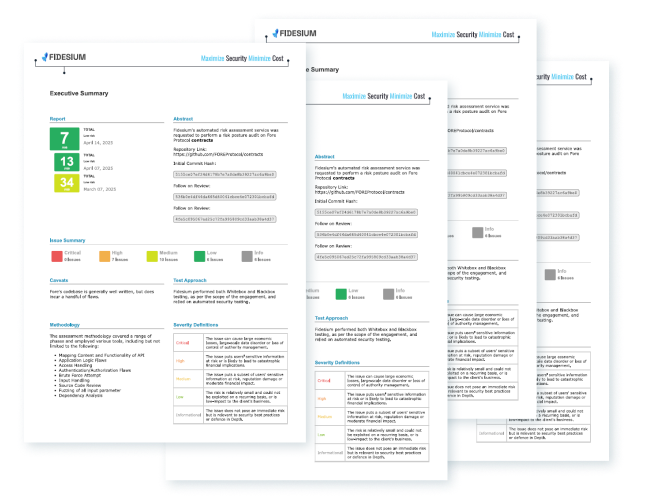
Audit evidence, recorded on-chain

Maintain a verifiable, immutable record of what was audited – and when – as your code evolves.

Provide verifiable audit evidence to investors and partners
Support exchange and ecosystem reviews with version-linked attestations
Offer transparent, public proof of audit history

Security credibility that holds up over time

Without a way to preserve audit relevance, confidence erodes between releases.

Fidesium helps teams:

  • Preserve audit value as code evolves by tracking which changes affect prior review scope
  • Reduce unnecessary re-audits by re-analyzing only where logic or assumptions change
  • Demonstrate audit coverage over time, not just at a single release
  • Treat security as infrastructure, with audits, updates, and evidence connected by design

With Fidesium, manual audits don’t expire silently.

They’re supported by continuous, version-aware analysis that keeps security defensible as systems evolve.

Our partners

FAQ's

How is Fidesium different from traditional audits?

Traditional audits review your code at a single point in time.
Once code changes, the assumptions behind that audit may no longer hold.

Fidesium extends the value of audits over time.
It supports both manual and automated audits by re-running audit-grade checks when meaningful code changes occur, helping teams understand what remains covered, what needs review, and why.

This turns audits from static reports into version-aware security evidence.

Yes.

Fidesium is built to support and extend manual audits, not replace them.
It helps teams reduce unnecessary re-audits and makes future audits faster, cheaper, and more predictable.

No.

Fidesium operates at the code and release level, not at runtime.
It focuses on preserving audit validity across versions, not detecting exploits in production.

This keeps results deterministic, reviewable, and suitable for audit, investor, and exchange requirements.

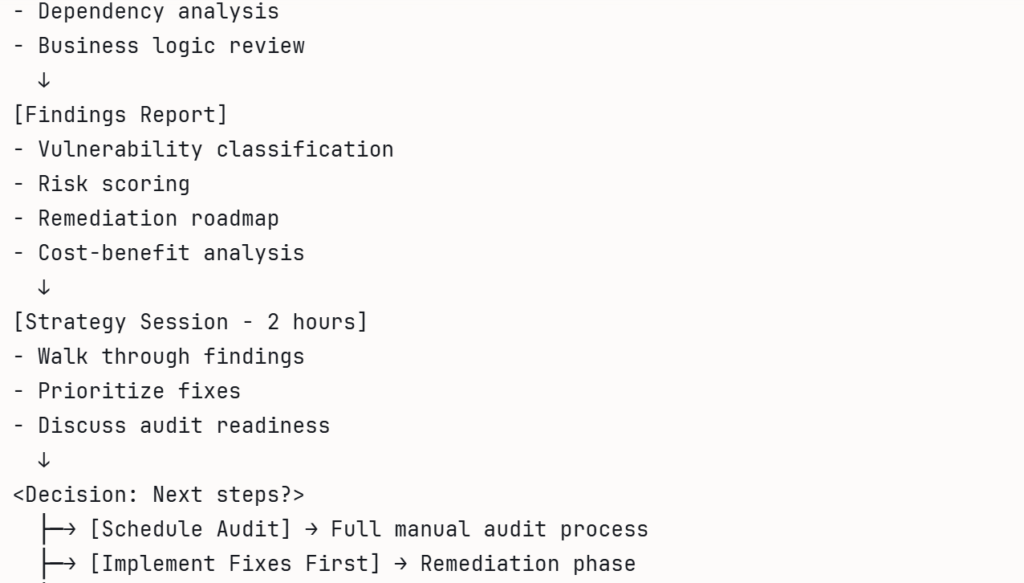
Fidesium provides expert-led manual smart contract audits, supported by continuous, audit-grade analysis that preserves audit validity as code evolves.

Teams can engage Fidesium for standalone audits, or use the platform to maintain and extend audits across releases.

Ready to make your audits last?

If you’ve already invested in audits,
Fidesium helps you preserve their value as your code evolves 
with expert review and continuous, audit-grade validation.

Discuss manual audits, automation, and audit continuity with our team.